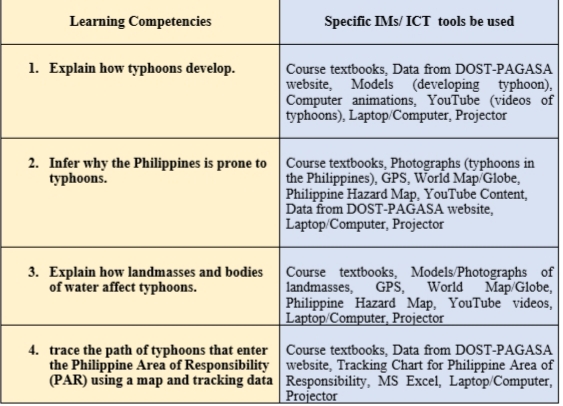
It is crystal clear that in this present time technologies are essential tool for teaching and learning. Several researches show that instructional materials have large effects on the student learning. It allows the students to discover the ability in dealing the subject. On the other hand, it also helps teachers to teach well their students with ease and comfort. According to some study, instructional materials are those print and non-print items utilized in the educational process to have an informative impact to the students. In the illustration below, it is shown how the specific IM’s or ICT tools being used in conducting a class in Grade-8 Science (Earth and Space), particular lesson containing the different competencies. The IM’s and ICT tools that contribute ease and help the teachers to conduct a class properly and effectively either flexible learning or face to face classes.
ICT Tools for GRADE 8- Earth and Space 2nd Quarter, Unit 1: Module 2
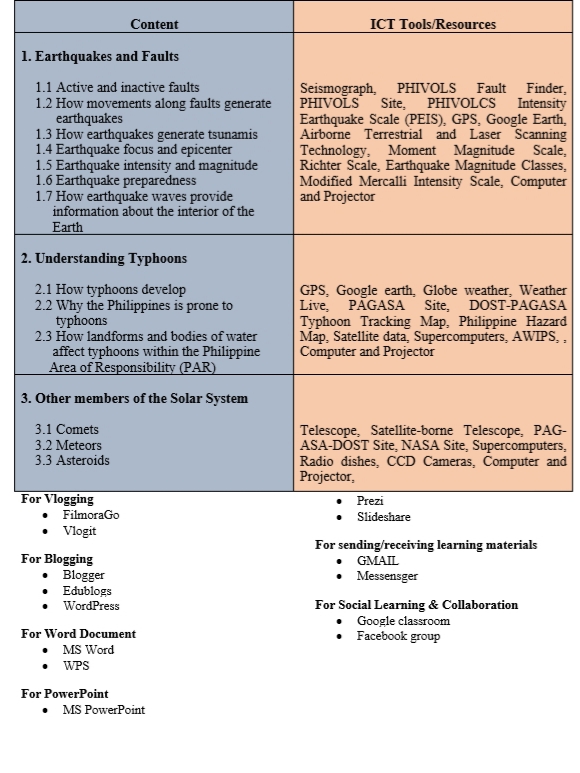
Instructional materials can serve as learning materials for both teachers and students. It serves as a primary source of science content, nature of newly introduced scientific practices and how a particular scientific knowledge is acquired and developed. Through the development and progress of the educational curriculum, the instructional materials used in teaching needs to adapt to the changes it undergoes through utilizing the technology. An ICT based instructional materials is a need to suffice the students’ capability to learn. Additionally, the instructional materials used in K-12 science classes provide the basis for what students can learn and what teachers should teach. The materials that align with science education standards and that take into account about the teaching and learning of science. One specific subject in science is the Earth and Space. To be more specific, in Grade 8 Earth and Space Science contain sort of topics that are related to the occurrence of natural phenomena such as earthquakes, typhoons and the happenings of some celestial bodies above. By that, teaching this subject in the classroom or in the laboratory requires a massive and specialized tools and equipments in order to introduce the topics to the students. As teachers, it is important to bear in mind that utilizing ICT as tool in learning this subject making it more tangible and possible to happen so that the learners might understand better the topics. The illustration below shows the different ICT tools that serve as the instructional material being used in order to introduce the several topics in Earth and Space science. It also contains the means of creating, making and delivering the activities that are needs to comply related with the said subject.
ICT Tools for Grade 8-Earth and Space The following are ICT tools useful for teaching and learning Grade-8 Science (Earth and Space) second quarter:
The project-based learning plan is an instructional method centered on the learner. It serves as substitute for using a long process of lesson plan which suggests following a specific path of learning outcomes or objectives. In project- based learning it allows the learners to have a wide-range understanding of the topic intended for them to learn. Project-based learning competencies are evidence-based. The teacher needs concrete evidence that the student has achieved a certain level of competence based on submitted products and projects (Santos, 2007, p. 35). According to Blumenfeld, the essence of project-based learning is that a question or problem serves to organize and drive activities; and these activities culminate in a final product that addresses the driving questions. The main goal of project-based learning is creating an active connection of pupils to educational process. The realization of this plan depends on the learners, through their critical thinking, creativity and motivations. Teachers should develop a unique plan in order to get the attention and interests of the learners.
Photo Source: Realinfluencers
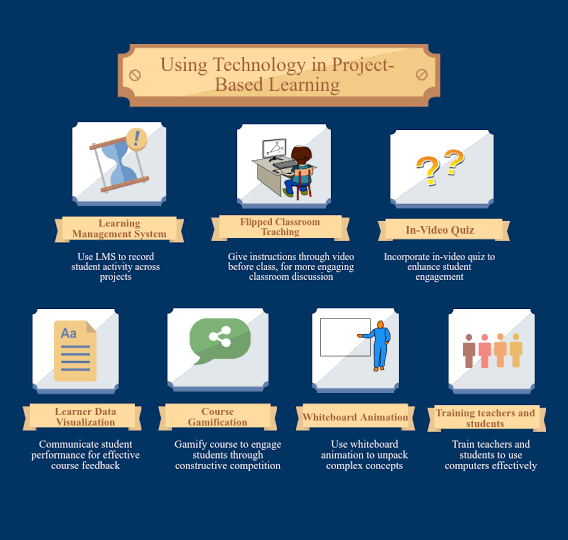
Presently, through the changes and reforms of pedagogic aspects, project-based learning becomes a favorable teaching process that helps learners to deal better with their learning curriculum. Through the integration of ICT in creating this plan, it makes a variety of learning opportunities possible. Project-based approach becomes more creative together with the aid of technologies. It challenges the active thinking skills of the learners. According to research on the use of ICTs, they offer many possibilities including increased motivation, better development of critical thinking skills, and greater student autonomy. Projects can be used to enhance students’ learning motivation and help students to engage into the learning activities. If the outcome of the project-learning plan is successful this shows the students ‘progress and motivation. Clearly, the integration of technology in project-based pedagogy seems to be recognized by teachers as a strategy that can increase student motivation.
Photo Source: eLearning Industry
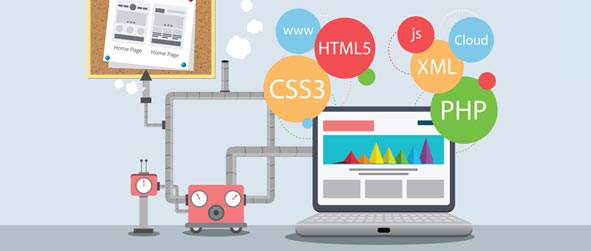
Specifically in the Philippines, the Department of Education (DepEd) is the one who create and produce a general outline of learning plan in almost all of the subjects in the basic education with the K-12 Curriculum. In the said learning plan, they also involved the integration of ICT in order that the intended objective in the subject shall be recognized easily by the students. In particular, science subject sometimes requires the aid of technology so that the students understand sufficiently in a given topic. But before a teacher could conduct an ICT assisted class, through their innovative and creative minds, teachers should formulate first on creating an ICT project-based learning plan in Science that covers the curriculum requirement. Based on the structure of learning plan, it contains the learning area, learning competency, learning task and mode of delivery. Teachers usually integrate ICT in the learning task and mode of delivery. They involve in the learning task some sort of videos, blogs and other educational online platforms that intended for students for them to watch and read making them to understand better the learning competency in Science subject. As early in the basic education, teachers should practice their students engaging and appreciating technology, that is why in the learning plan they recognize the use of Google classroom, messenger and even video conferencing serve as mode of delivery of the learning process where teachers could pass the modules to their students and also students where they could pass their outputs. The convergence of ICT in formulating the learning plan in science help both teachers and students to understand better the given topic together with ease of delivering it.
Photo Source: Pinterest
Convergence of ICT assisted project-based learning plan in Science teaching will triggers the interest of the students and creating them an opportunity to become independent learners. Talking first to those students who are “non-science majors” but still there are some subjects that they should still have to study about science also including those students who are really enjoy science subject. For teachers it is a challenge for them to teach those students but through ICT project-based learning plan in science, even though students were diverse, it allows them to have an opportunity to make a unique contribution to the project related to science and so it will make an invaluable impact to their interest and knowledge in science. In addition, for those students who are science major or even those students who really love science, the pedagogical process of project-based learning in science contains a context of making the students to engage in authentic investigations through the use of driving questions, and this allows the students to brainstorm their ideas, utilizing technologies to seek and find solutions. Through driving questions, it links concepts towards the learning plan. Moreover, through the support of the teachers in conducting the ICT assisted project-based learning plan in science it allows the students to design and perform various investigations to find solutions to the driving questions.
Photo Source: Edsys
Lastly, project-based learning plans while utilizing ICT is relatively useful at this time not just only in science teaching but also in all subjects or courses. For teachers, it would help them to create a better plan in teaching. On the side of the students, this would help them to have an essential and beneficial way of learning.
The COVID-19 pandemic has move many aspects in the society. It is a battle between humanity against the unseen enemy. A lot of lives suffer, and many lives had been offered but still the battle against this deadly virus. Economy goes down, essentials and non-essential travels have been regulated and mostly face to face classes in education suddenly stop due to some health protocols mandated by the government. On the other hand, learning should not stop, despite of this challenging moment. Both teachers and students should learn to adapt the new reform of pedagogical and educational process which known as distance learning. In order to make the distance learning an effective approach in education the use of Information and Communication Technology (ICT) is a need and a must to suffice the learning process.
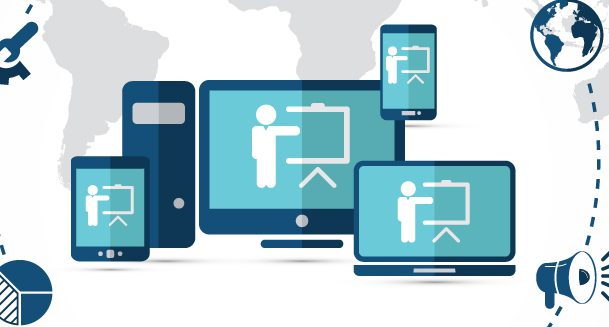
ICT define as… Several definition of ICT was introduced by different person and institutions. For instance, UNESCO define ICT as “a scientific, technological and engineering discipline and management technique used in handling information, its application and association with social, economic and cultural matters”. Simply, Information and Communication Technology defines as the technologies primarily provide communication and information through the use of any communication devices and application, its either hardware or software includes mobile devices, computer, laptops, radios, televisions and other devices and services which scope is providing information and communication utilizing ICT.
Types of ICT Additionally, in order to become ICT implicates its role as an immediate source of information dissemination as well as continuing the flow of learning, there are some types of medium being created, innovated, and used that clearly shows the ease and development brings buy ICT, importantly in the field of education. The following are the types of ICT commonly used:
• Mobile device A very convenient technology that suffice easily the flow of learning process and provides easy access to educational activities.
• Educational Network An online platform that allow the student to use social networking technologies somewhat similar to Facebook.
• Web-based These are network application promotes the student to connect to each other that generates educational content and purposes.
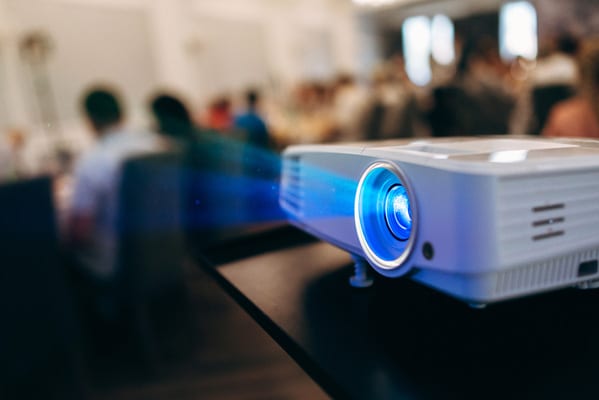
• Classroom Equipment The technologies used in a traditional classroom setting that helps learning process more interactive.
• E-creation tools These are software application that allows student to post and publish their creative and original works.
• E- communication tools Software that helps students and teachers to communicate either it is in real time or with a time delay.
• Reading/Writing Facilitative e-tools Online software that promotes students to seek some educational content and also posting their original write ups.
• Listening/Speaking Facilitative e-tools It is based on audio or video that delivers the topic and develop the students’ listening skills.
• E-assessment tool The usage of ICT to have an assessment regarding to the topic and it was created through blog or vlog.
• Virtual Learning Environments A web-based platform promoting the student and teachers to segregate, manage and submit their works.
Integration of ICT and Education… The integration of ICT towards education is a fruitful reform, development and approach on the teaching and learning process. During the bombardment of the global pandemic brought by COVID-19 virus, it hinders and blocks the way of teaching and learning process. The educational system was being challenged on how to continue on delivering and transferring knowledge to the students amidst the prohibition of having face to face classes. In such way, the education sector finds its way adapting, utilizing and integrating ICT in learning on this challenging time. Teaching and learning process rely in the distance learning on which student choose where they feel comfortable its either online or modular class.
To be more specific, science teaching in the institution requires more on laboratory works and actual performance on the experiments enabling to find out if the students clearly understand the given topic. But, due to the prohibition of going to school, teacher and students was not able to conduct such requirements, instead, it also adopt online and modular approach. Utilizing mobile devices, computers, laptops and wireless connection is a need. Through of that action, teachers will find a way on how to teach students quite the same of having actual performance and laboratory works. Furthermore, way back on the time of having face to face classes, still ICT finds its way to facilitate the traditional classroom setting through the use of classroom equipment such as projectors and monitors. In doing such way, the teaching and learning process become more interactive and lively. Clearly, ICT plays a vital role in the education system and learning process whether face to face classroom setting or distance learning. The advent of technology in the past bears its fruit now at the present through utilizing ICT. Lastly, the reform brought b ICT on the pedagogical and educational process improves classroom setting and helps the institution to conceptualize and promote electronic learning as an effective approach in learning.
I spend more and more time at my desk these days, doing everything from preparing the family taxes to working on this blog. Because of this, my workspace is constantly changing. Holding the clutter at bay is challenging, so I prefer to keep nearby only a few quality items that serve multiple purposes over a stockpile of things I might never need.
My planner is one of those simple ring binder journals you can pick up from any stationery supplies store. White paper. No ruled lines to cage my venturesome handwriting and doodling. I’m an obsessive note-taker and fill pages to the margins with to do lists, rough sketches, and ideas for blog posts. I usually go through one planner every month.
Who me? Organized? My husband might tell you otherwise, but I do find it hard to keep track of our weekly schedule. You know: school, swimming, grocery shopping, tidying up, paying bills, remembering appointments and so on. Fortunately, in our house we all pitch in. No one person does everything. But we do have a little secret that helps our day run more smoothly.
There are millions of tips out there on how to fly with kids, what to bring on camping vacations, which suitcase to buy, where to go and what to see in just about every corner on Earth. What I want to share today is something a little different – something that we discovered last summer during a family hike in the Appalachians.











 Technology For Teaching and Learning